
Horror as Moral Weight
What Gumdrop Taught Me About Violence, Victimhood, and the Stories We Need

Film / Horror / Morality · Sunday Evening
Someone on Threads asked me recently why horror and God keep showing up together. Why so many people of faith are drawn to the genre. Why the darkest films so often carry the heaviest moral weight.
My answer was simple: horror is where morality gets stress-tested, not resolved.
I have been thinking about that exchange ever since, because it cuts directly to something I have wrestled with for years as both a filmmaker and a writer. And nowhere has that wrestling been more personal than with my horror film, Gumdrop.
Warning ⚠ This essay discusses “Gumdrop”, a short horror in full, including 3rd act.
If you haven’t seen it yet, consider watching it first — it’s worth the unguarded experience. Or if ever speaking to others who may end up watching it, please do not to spoil the film’s conceit.
What the Film Is
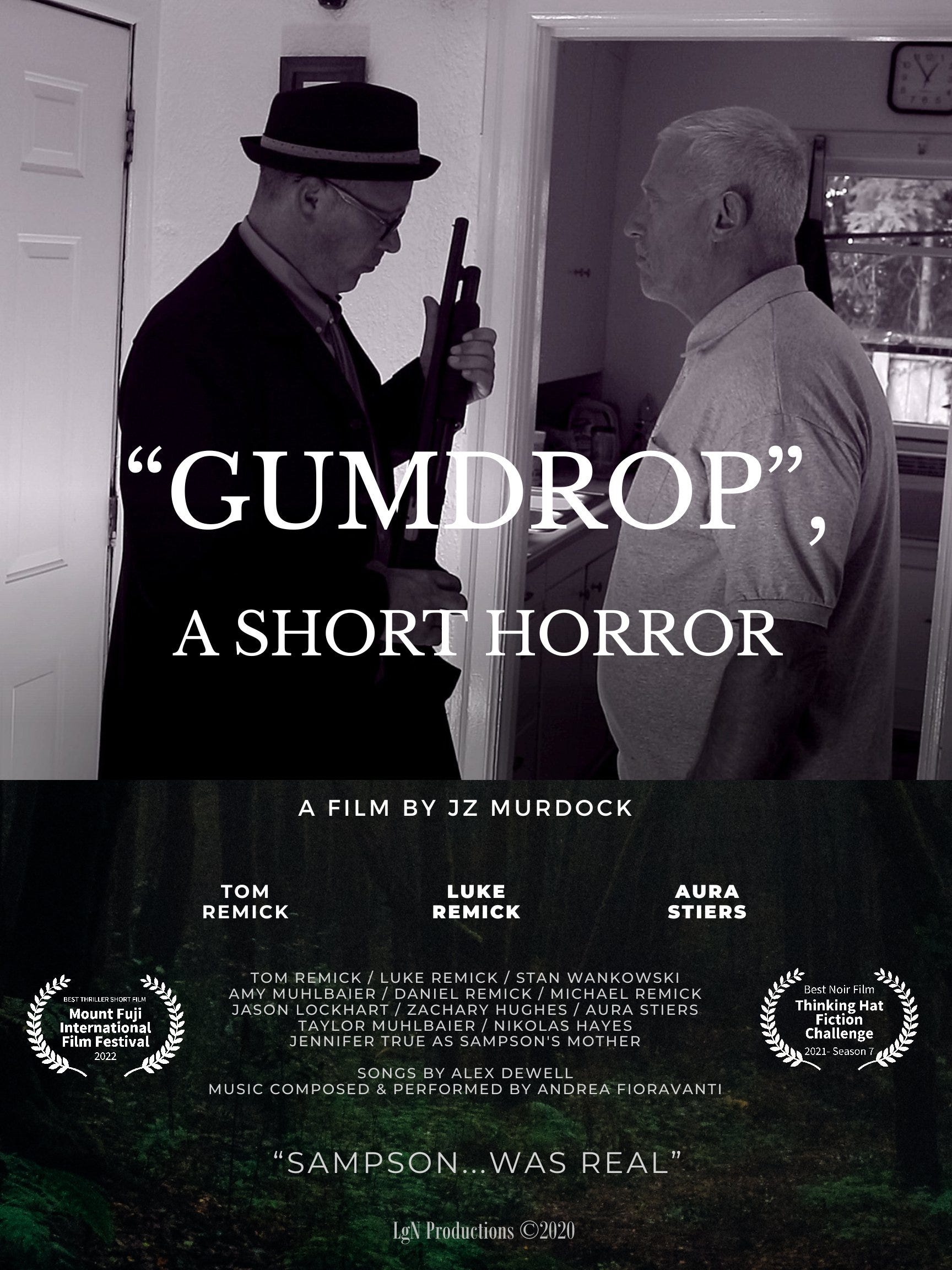
“Gumdrop”, a short horror is a short noir horror film, a prequel film to the 2012 published true crime short story, Gumdrop City (first penned in 1983) that has earned 17 festival awards. It comes across as a rather rough film, but if you consider it in the sense of films like Henry, Portrait of a Serial Killer, you’ll get the idea.
I had Henry in mind when I wrote it, while it was in principle photography, and through postproduction. There is a lot going on in this film that most will miss, thinking it’s just a low production film. It’s more than that as the awards indicate. Something else is going on there…
It is the origin story of a character named Sampson — a child serial murderer and cannibal operating out of a stolen house, a house he has taken over, the kids supplied by hit men and a hit woman who do not want to be doing what they are doing, but are bound to him by something the film never fully explains.
That ambiguity is intentional. Coercion rarely announces itself cleanly.
The children brought to Sampson have terminal illnesses. That detail is not incidental. Nor is it made apparent until the third act as the film takes several abrupt turns in its storyline. It is the film’s most precise moral horror — the suggestion that someone has decided these children are already lost, already expendable, and that this calculus is what makes the transactions possible. There are many metaphorical elements in the story and the film.
The film ends with Sampson wounded, having been stabbed by the woman he has held captive in the basement. It is her final gesture. Hearing a knock on the front door, he answers the door, sees a familiar hitman, and disgruntled, tells him he can have the house, and walks out. The hitman, pleased with the windfall, tells the child — a child he had drugged and brought to the house for Sampson — a child he never wanted to supply in the first place (something never explained in the film) — a child who at this point has no functional capacity to choose anything — to get lost.
Ironically, the child runs after Sampson and takes his hand in the yard. Surprised, Sampson turns, looks directly into the camera, and smiles. He then walks away with the child, quite oblivious, beside him.
Later, after the mid-credits sequence, Sampson walks along outside, homeless again with a duffle bag (containing yet another child). He taps a missing child poster and says, “Now you famous too.” And walks off out of camera frame.
Off camera, we hear a car. Whether he survives is left to the audience.
He does survive. He has to. This is after all, a prequel film to the original true crime short story.
But that is the sequel’s problem.
The Creative Constraint I Didn’t Anticipate
When I began writing the screenplay, I discovered a problem I had not seen coming.
I could not kill Sampson. Historical morality in a horror film says the bad guy dies. Except in the franchises such as Freddy (a dream character who can affect reality). Jason, an unkillable serial killer monster from Friday the 13th franchise. Michael Myers in the Halloween franchise, who repeatedly survives, with no final death, until recently in ending the franchise.
As stated above, Gumdrop is a prequel to my short story Gumdrop City, in which Sampson’s secret is discovered in yet another house — by the neighbors who notice what a weird character their neighbor is and dogs seem disturbed by his house, even when he’s not home. And he keeps odd hours. One neighbor and a dog enter the house as neighbors stand about curious. Until all hell breaks loose inside.
But that’s not what actually happened.
In official police reports, neighbors called the police because of a smell. Police find what they find, and arrest the homeowner, “Sampson” (not his actual name). The true case that partly inspired the story, is one I learned about from my abnormal psychology professor at university (toward getting my degree in psychology), who told our class he had been asked by police to accompany them into the scene.
What they found on those shelves in a closet, I will not describe or burden you with here. The image has stayed with me for decades. That professor had some very adult descriptions of the psychologically unbalanced people he had worked with or crossed paths with before turning his career to teaching.
Because that story exists, and because Sampson had to be present in it, the film I was making had to deliver him intact to that future moment. The prequel was in service to the sequel’s truth. Thus, the car at the end of Gumdrop was the only honest solution I could find — ambiguous enough to satisfy the audience’s need for moral consequence, truthful enough not to betray the canon.
There is a specific frustration in being locked out of your own ending. The film’s internal logic wanted a reckoning. The larger story refused to allow it. What you are left with is a compromise — and the question of whether the compromise is a failure of nerve or an accidental truth.
I think it turned out to be an accidental truth. Because in the real case that lives behind all of this, there was no dramatic reckoning either. There was a smell. A neighborhood complaint. A phone call to police. Evil at that scale does not end cinematically. It ends bureaucratically, almost by accident, almost too late. The murderer was simply arrested, incarcerated, tried and given psychological treatment in a mental facility.
People are not typically evil, just damaged. It is in their actions where the evil may arise. This calls to my belief about capital punishment. I do not believe the State should murder its citizens. Even the worst of us can one day prove useful to humanity. But from time to time, very seldom, there are those individuals where the best course for humanity is to simply end their existence, and move on. The problem I find with politics, is some political orientations profess that the number of human beings, of citizens of the State, are of vastly larger numbers.
But that is a topic for another time and place and one that I have ruminated on many times, elsewhere.
The car in the offscreen is more honest than any ending I could have written deliberately.
The Child Who Runs Toward Him
The moment that troubles people most is the child running after Sampson when he leaves.
It’s important to understand what that image actually is. The child has been drugged. They have no remaining framework for threat assessment. They are not drawn to him by trauma bonding or some psychological identification with her captor. They run to him because the machinery of what has been done to them has stripped away the capacity to run from anything at all.
That’s a precise statement about victimhood — not the romanticized version, not the version that implies agency or complicity, but the actual mechanics of how predation operates at its most complete. The child is not choosing. The child has been made incapable of choosing. Sampson’s smile into the camera is his acknowledgment that he knows this. That we know this. That we are now implicated in knowing it and watching anyway.
Why Horror and God Are the Same Conversation
Back to the question from Threads.
Conventional morality tales have a shape: transgression, consequence, restoration of order. The monster is punished. The community is healed. The lesson is legible. This is satisfying and it is largely a lie about how evil actually works.
Horror at its best refuses that shape. It is not nihilistic — nihilism would be easier. It is something harder: morally serious without being morally comfortable. It insists that some things cannot be resolved, only witnessed. That some damage cannot be undone, only understood. That the question of why such things are permitted to exist in a world overseen by anything — God, law, community, conscience — does not have a clean answer.
That is precisely the terrain theology has always occupied. The Book of Job is a horror story. Gethsemane is a horror story. The Psalms of lament are horror stories. The genre and the faith have always been working the same ground from different directions.
What Gumdrop does — what I hope it does — is refuse to make Sampson a monster in the cartoon sense. He is coherent. He has preferences, aesthetics, a system. He is more disturbing for it. Because the true horror is not the supernatural. It is the human being who has organized an entire life around this, who has suppliers and logistics and a house, who smiles at a camera because he knows exactly what he is and has made his peace with it.
What This Has to Do With Saturday’s Essay
Yesterday I wrote about AI, intention, and why the real danger has never been the technology — it’s always been the people deciding what to do with it.
The connection is this: we process moral scale better through narrative than through argument.
Statistics about children harmed do not land the way a single child — drugged, discarded, running toward the one person who should be the threat — lands. Policy papers about violence do not do what a filmmaker’s impossible constraint does to a reader who suddenly understands that the story is not fiction all the way down: I cannot kill him. The larger story will not allow it.
Horror makes weight felt.
The AI piece I wrote yesterday makes the mechanism legible — who builds the tool, who aims it, and why. Both matter. But one of them gets inside you and stays.
The question the woman on Threads was really asking, I think, was: why do we need to feel the weight at all? Why not just reason our way to right action?
Sampson smiling into the camera is the answer.
You can know everything about what he is and still feel the smile land differently than the knowing did.
That gap — between knowing and feeling — is where both horror and faith have always lived. And it is, I would argue, where any serious reckoning with violence in this culture eventually has to go.
As always…
Cheers! Sláinte! Na zdravie!
“Gumdrop”, a short horror is a JZ Murdock / LgN Productions short film. 17 festival awards. The companion short story sequel Gumdrop City is available through Last Good Nerve Press.
JZ Murdock is a filmmaker and author based in Bremerton, Washington. His short filmic poem and antiwar documentary Pvt. Ravel’s Bolero has won acclaim worldwide from many international festival awards.
The film companion book is forthcoming.
If this work means something to you, you can support it at Ko-fi. Tips are always welcome and go directly toward keeping independent documentary work possible.
Yesterday’s related article: Level 1 Rights, Level 100 Weapons