
Intent vs Interpretation: Where Film Criticism Goes Wrong
Accident, authorship, and the meaning that survives the cut

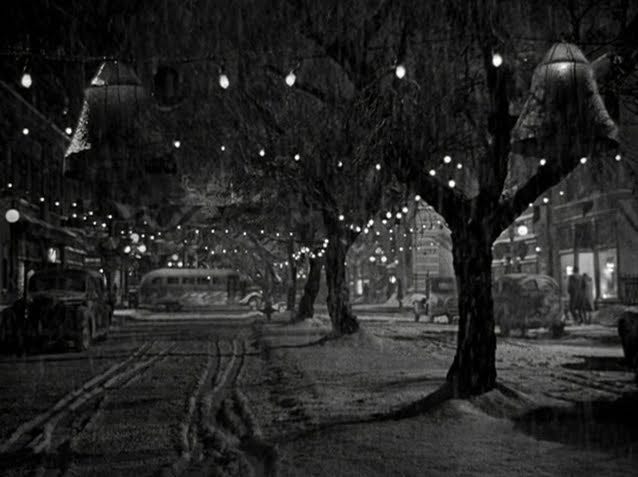
Bedford Falls - It’s A Wonderful Life - Frank Capra
There’s a short opening in a scene from Better Call Saul—something natural, suspended improbably outside a suburban home by what appears to be a single spider thread—that raises a familiar question:
Was this intentional symbolism, or was it simply there?
Did Vince Gilligan and his team design it as metaphor—fragility, entrapment, inevitability—or did the crew arrive, notice it, and say, “That’s interesting. Roll camera.”
This distinction matters less than people think—and more than they realize.
Intent vs. Inclusion
In production reality, not everything is designed. Weather intrudes. Light shifts. Props misbehave. Nature does what nature does. Crews are pragmatic.
The key question is not “Was this planned?”
It is:
Once noticed, was it used?
Film language is not authored solely at the script level. It emerges from selection. The camera does not merely record; it chooses. And once something is chosen—framed, lit, held—it enters the grammar of the film whether or not it was storyboarded months earlier.
A happy accident does not remain an accident once it survives editorial judgment.
The Fallacy of Over-Reading (and Why It Persists)
Audiences—and critics—love intentionality. We want symbols to be deliberate because it reassures us that meaning is controlled.
But cinema history is full of examples where meaning was retroactively assigned to what were, frankly, accidents.
It’s a Wonderful Life is a classic case. For decades, viewers and critics have decoded moments—lighting glitches, performance tics, background actions—as deeply symbolic or thematic, when production records show they were unplanned, sometimes even technical mistakes.
Yet here’s the uncomfortable truth:
Once a film is locked and released, the accident no longer belongs to production—it belongs to interpretation.
Meaning is not revoked because it wasn’t intended.
The Filmmaker’s Real Skill: Assimilation
A filmmaker uses all he can.
The question on set is rarely “Should we stop and reset?”
It’s “Does this serve the moment?”
If the answer is yes, then assimilation—not correction—is the mark of craft.
This is not sloppiness.
It is responsiveness.
Cinema is not architecture; it is closer to navigation.
Auteur Theory, Properly Understood
If we invoke auteur theory, we should do so carefully.
François Truffaut argued that a director’s authorship is visible not in total control, but in consistent judgment: taste, selection, recurrence.
Likewise, in the Alfred Hitchcock sense of authorship, control mattered—but even Hitchcock was pragmatic. He used what worked. He did not discard a compelling image because fate placed it there instead of the storyboard.
Auteurism is not about omniscience.
It’s about what survives the cut.
If the spider-thread image remains, it is because it passed through multiple filters:
the director’s eye
the editor’s rhythm
the showrunner’s sense of tone
the network’s acceptance
At that point, arguing whether it was “meant” is almost irrelevant.
The Final, Unavoidable Truth
Once a film is released:
Everything in the frame becomes part of the language of that film.
Not the language of intention.
The language of cinema.
Interpretation is not invalidated by accident. Meaning does not require permission from the filmmaker’s original plan.
Cinema is a composed art—but it is also an adaptive one.
And the most honest filmmakers know when to stop fighting reality and let reality speak in their voice.
That, arguably, is authorship.
When Accidents Become Film Lore
So what are some of the moments that have entered cinema history this way?
It’s a Wonderful Life — the streetlight
During the scene where George Bailey runs through Bedford Falls after realizing his life mattered, a streetlight visibly malfunctions—its bulb flickers or goes dark at a key emotional moment.
For decades, viewers interpreted this as symbolic punctuation:
the darkness before renewal
the town “waking up”
the world responding to George’s emotional state
Production accounts indicate it was not scripted—simply a technical hiccup.
Frank Capra did not stop the scene. He kept rolling.
Once it stayed in the cut, it ceased to be an accident and became cinematic language.
Casablanca — the foggy airport
The heavy fog in the final scene wasn’t symbolic design. It was used to:
hide the fact that the plane was a miniature
mask a limited set
Audiences, however, read it as:
moral ambiguity
emotional uncertainty
a liminal space between love and duty
Accident → necessity → meaning.
Jaws — the shark that didn’t work
The mechanical shark failed constantly. Spielberg was forced to not show it.
That technical limitation created:
suspense
dread
restraint
What began as malfunction became the defining language of the film.
Apocalypse Now — real chaos on set
Weather, illness, breakdowns, even real military hardware drifting into shots—all unintended.
Francis Ford Coppola absorbed reality instead of controlling it, and the film’s instability became its thematic spine.
The Director on Set
There’s another side to this:
problems on set that alter the film itself.
I’ve had things happen during production that forced changes—not cosmetic ones, but changes that reshaped the film’s direction. Two things matter in those moments:
You have almost no time to think.
You still have to act.
When disaster hits, your heart stops. Fear creeps in—briefly. Then you realize people are waiting. The shot isn’t finished. The day isn’t over.
So you act.
Once you accept that the plan is broken, something interesting happens: you calm down. Solutions appear. You begin to see not just a path forward, but how that path might strengthen what you’ve already shot.
That’s when it gets exciting.
Actors feel the derailment immediately. So does the crew. If the director panics, the set collapses. But if you find the path and let that energy show, the room changes. People start seeing what you see.
You want them to leave energized—ready for tomorrow.
Those changes?
Those fixes?
They become part of the film’s meaning. Its direction. Its lore.
No matter how small the production.
Closing
Cinema is not weakened by accident.
It is defined by what the filmmaker allows to survive the accident.
Auteurship is not omnipotence. It is judgment—especially when reality intrudes. Discredited or not, that distinction still holds.
And that is the world—and the language—of film.
Cheers! Sláinte! Na zdravie!