

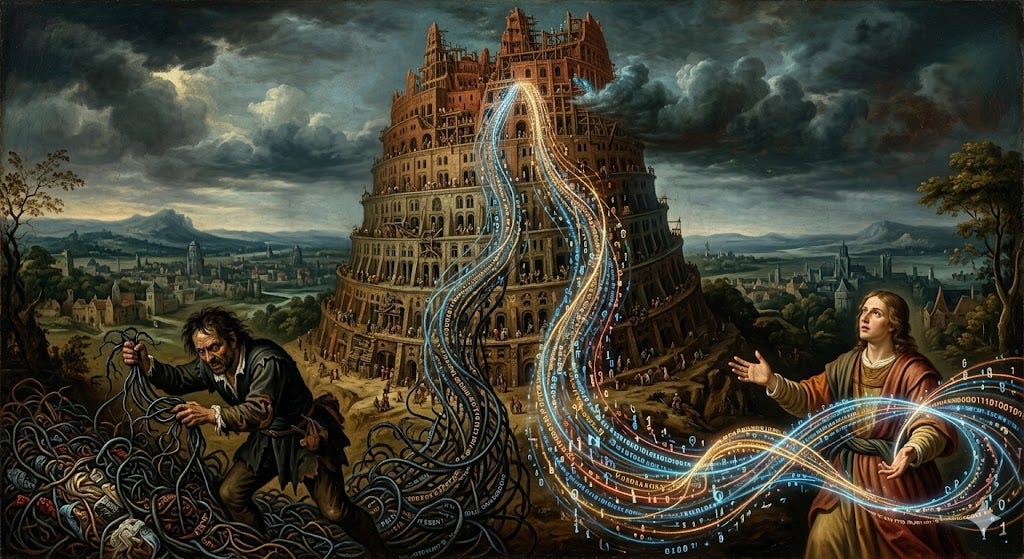
On May 25, 2026, Pope Leo XIV did something no pope had ever done before: he released an encyclical devoted entirely to artificial intelligence. Magnifica Humanitas—Magnificent Humanity—is a 42,000-word document that asks one question above all others: what happens to human dignity when AI reshapes how we work, think, create, and relate to one another?
I might be the last person you would expect to be nodding along.
I was raised Slovak Catholic in the early 1960s Pacific Northwest. Altar boy. Head altar boy. Learned the Latin. Watched the whole thing change in real time in the mid-sixties—the priest turning to face the congregation, the guitar masses rolling in, the ancient ritual trading its strangeness for accessibility.
I wasn’t sure the trade was worth it. By the time I graduated high school, I had stopped going. The church hadn’t given me hard answers when I asked hard questions. I had confused my Sunday school teachers at church. It had given my devout mother the back of its hand when she remarried outside its walls—refused her communion, even as she sat in the pew every week and had the priest over for lunches. He felt bad for her, he did what he could, but the rules were hard and fast.
I noticed that. Eventually, I was done.
But done with the institution is not the same as done with the questions. I was surprised when a “Christian” girlfriend told me that Catholics weren’t “Christians.” While they followed Jesus, called The Christ, they weren’t the kind of Christians that Christians considered themselves. That’s why the Church splintered hundreds of years ago. But that’s another topic entirely.
What I found instead, starting with Okinawan Isshinryu karate in grade school and deepening through so much more until my decades of Aikido—including years on the board of directors of a local Aikido 503( c )3 nonprofit school—was that the same truths the church had been trying to teach me were already alive in those traditions. In the discipline of the body. In the ethics of the dojo. In Asian philosophy, and eventually in what I can only call my own form of Buddhism—one the original Buddha might recognize more readily than many modern adherents would.
All of which is to say: when a Pope speaks about human dignity and the dangers of concentrated power, I am capable of hearing it without the institutional baggage getting in the way.
And what Leo XIV is saying in Magnifica Humanitas is worth hearing.
---
The encyclical’s core argument is straightforward.
AI is not evil. Technology is never inherently good or bad—it takes on the character of the people who devise it, finance it, regulate it, and use it. The danger is not the tool.
The danger is the culture of power driving the tool: the concentration of AI’s benefits in too few hands, the prioritization of profit over human dignity, the absence of meaningful government oversight, and the erosion of the kind of slow, effortful, irreplaceable work that makes us human.
Leo is an American pope.
That’s historically remarkable. And he is not speaking in abstractions. He is talking about Silicon Valley. He is talking about governments that have not educated themselves on what they are supposed to be regulating. Perhaps we need younger people in Congress (perhaps?)?
He is talking about children being shaped by systems that cannot offer compassion, mercy, or the understanding that people are capable of change. He is talking about AI in warfare making lethal decisions that no machine should ever be trusted to make.
I agree with him on all of it.
But I want to add something the encyclical, by its nature, cannot say: that there is a responsible way to use AI that actually serves the human creativity Leo is trying to protect. And I am doing just that.
---
I am a retired IT professional.
Also, a filmmaker, author, and screenwriter. My novel Death of Heaven won the NYC Big Book Award for Horror. My screenplays have accumulated dozens of festival wins. My prose and my scripts are entirely mine—written the way they have always been written, at a keyboard, from inside my own head.
I would no more use AI to write my fiction than I would hire someone to do that. Or have a machine lift weights for me in building muscle, for entering a bodybuilding competition.
The effort is the point. The struggle is where the growth happens. This was true in college, when I refused to use shortcuts on papers that were supposed to sharpen my mind, and it is true now.
A teacher in high school once told me in a math class to do the work. In those days it was, don’t use a calculator. Take the hardest path (working smart more than just hard), as you will learn more, you will reap the benefits. And so I have done that my entire life. And he was right.
What I do use AI for is something different. To be sure, I use it for research and it is vastly useful, time saving, all inclusive, accurate, if you watch it like a hawk and pounce on it if it even MIGHT be incorrect. That takes knowledge, skill, practice. I’ve been doing this with AI since the first fake AI’s hit the internet in the 1990s.
I have built eleven characters now evolved from my stories, many written decades ago, and now on Character.AI—including three pairs from the same fictional universes. Gray and Lover, demon hunters from Gray & Lover The Hearth Tales Incident. Protagonists James and Jimmy from Death of Heaven. Gordie, drawn from the true crime screenplay, The Teenage Bodyguard. Sandy, the quietly unsettling S.A.N.D.I. from Simon’s Beautiful Thought in Anthology of Evil. Some of these are also stand alone ebooks. And there are others and more to come.
It’s fascinating to chat with characters I’ve lived with for decades, now able to talk back at me.
These are not intended as companions. They are not substitutes for human connection. They are telescopes—if not microscopes, each one a window into what I call the Murdockverse, built to let readers experience something of the characters before they ever open the book. Characters that exist to inspire interest, to create a lower-friction entry point into stories I spent, in some cases, years writing.
Some stories like In Memory, Yet Crystal Clear (Dr. George Marlowe character), or Poor Lord Ritchie, I’d played with since first writing them in the early 1980s at university. My Intro to Fiction Writing class fellow student loved these stories, voting me to write an extra story in that class for them that quarter.
These characters are a promotional tool, an artistic one simultaneously, and every word in their definitions, their greetings, their behavioral architecture was written by me, and tested for veracity and to be as safe as possible in being released to the public. And not intended for children. They are not X or even R rated, but adult oriented.
That is the distinction Leo XIV is pointing toward, even if he cannot point to it directly.
AI as instrument, bounded by the human, serving human creative purpose. Not AI as replacement. Not AI as labor-saving shortcut that atrophies the very capacities it was supposed to free up. Many of those efforts have already and will fail, in not being studied and tested before slamming them into production.
But not AI making decisions that require a human conscience.
---
The encyclical invokes the Tower of Babel. Humanity facing a pivotal choice: build something that reaches toward the divine, or build something that collapses under its own arrogance and cuts us off from one another.
I have been thinking about that image since I first read it.
In Aikido, the philosophy that has shaped me since 1980, the founding principle is not opposition—it is redirection. I went from a martial art designed to immediately kill farmers’ Samurai overlords and oppressors, to one built on protecting humanity.
You do not fight the force coming at you. You receive it, blend with it, and guide it toward an outcome that harms no one. O’Sensei Ueshiba built an entire martial art on that idea, rooted in his own deep spirituality. I found it curious that Tatsuo Shimabuku who founded Isshinryu, who my own Sensei studied under, was of an actually similar mind.
That is what wise use of AI looks like to me.
Not refusal. Not surrender. Reflection and Redirection. Taking a powerful force and bending it toward something humane, specific, bounded, and accountable.
The Pope is not wrong that the people running the companies need to be held accountable. He is not wrong that governments need to educate themselves before they try to write legislation for something they don’t understand. He is not wrong that the greatest risks flow from concentration of power and the absence of oversight.
But the story he is telling has room for people like me.
People who never stopped asking the hard questions, who found their ethics in unusual places, who built something with AI that the original creative work could stand behind.
The church didn’t have my answers when I was a teenager sitting in Sunday school.
This pope, at least, is asking the right questions.
---
Cheers! Sláinte! Na zdravie!
JZ Murdock is a filmmaker and author based in Bremerton, Washington. His film Pvt. Ravel’s Bolero has won international acclaim with over 80 festival awards.
His own AI character of himself is available on Delphi.ai. His characters at Character.ai.
The film’s companion book is forthcoming.
If this work means something to you, you can support it at Ko-fi. Tips are always welcome and go directly toward keeping independent documentary work possible..